guest post // Website Content Strategies to Keep Donors Engaged Year-Round
Guest Article by Jessica King, Getting Attention
Every nonprofit faces the uphill battle of maintaining donor attention and momentum after that crucial first gift is made. Even when supporters deeply believe in your mission, they often stop giving simply because the organization fades from their daily awareness or fails to communicate ongoing impact.
One of the most effective ways to bridge this gap is by treating your nonprofit’s website as a dynamic digital hub. Here, you can share updates and educational content that engage your supporters and cultivate their long-term support.
In this guide, we’ll provide some of the best tips and tricks for creating and updating website content so you can inspire your donors to continue supporting your organization year-round.
Use the “show, don’t tell” technique of storytelling
Data showcases your organization’s impact, but relying solely on it can inadvertently alienate your audience. So, to drive genuine connection, you must combine it with storytelling, as this is the foundation of all nonprofit communications.
In literary circles, “show, don’t tell” is a popular piece of advice, and it works well for nonprofits, too. This advice means that instead of simply listing organizational statistics, you should focus on narrative-driven impact updates. For example, if you just completed a food bank distribution, don’t just state how many meals you’ve distributed and how many people you’ve served. Rather, highlight a story of one family whose week was transformed by a recent community drive.
This is not to say that you shouldn’t weave some data into your narrative. In fact, it’s good practice that you do. Using the same example as above, you can mention that 15% of your community’s residents rely on food bank distribution. When you share these stories with a clear understanding of the community’s unique challenges, you’re demonstrating the organization’s deep understanding of systemic inequities it actively fights and positioning it as a reliable authority in resolving those issues.
Practice transparency to build trust
Trust drives donor retention. According to the Donor Trust Report 2026, nearly 70% of donors say that they need to know they can trust the charity before donating. It’s safe to assume your supporters will expect absolute clarity about how their contributions are used behind the scenes.
Aim to share financial realities openly. Post your annual reports on your website, then write blog posts that break down these reports and include infographics, charts, and graphs to visualize the hard data. Additionally, you can integrate brief financial impact statements on your primary donation pages so that donors know exactly where their contributions will go.
When you practice open communication about your successes and operational challenges with your supporters, you’re fostering a deeper sense of partnership with them, making them significantly more loyal to your cause.
Get creative with interactive and multimedia experiences
Static text can only hold a reader’s attention for so long before they navigate away from your page. To keep their eyes on your page a little longer, consider adding interactive and multimedia elements they can play with for a minute or so. Some examples include:
Videos: Give viewers a dynamic look at your nonprofit's impact by hosting short, high-quality clips directly on your landing pages to explain complex programs or share beneficiary stories. If you hosted webinars in the past, consider incorporating some snippets as well.
Interactive infographics and data visualizations: Allow users to hover over or click through specific data points, making dense financial reports or other statistics relevant to your organization easier to digest.
Image galleries and sliders: Maximize limited screen space by grouping high-resolution photos from recent events or volunteer days into a single swipeable carousel.
Quizzes and assessments: Drive active participation by testing visitors' knowledge of your specific cause, educating them and providing your team with valuable audience insights.
Polls and surveys: Gather immediate feedback on community priorities or event preferences by placing short, single-question prompts directly within relevant blog posts.
Calculators and tools: Empower potential major donors to see the exact real-world impact of their gift amount by allowing them to adjust numerical inputs in real time.
In addition to these multimedia elements, consider integrating your nonprofit’s social media feeds into your website. Doing so adds social proof for your organization and makes it easier for visitors to move seamlessly from one channel to another.
Map website content strategies to the donor journey
Treating all website visitors the same ignores the nuanced relationship between your nonprofit and its supporters. If you practice a one-size-fits-all communication approach, you’re isolating potential lifelong advocates by delivering the wrong message at the wrong time.
To prevent this, you should tailor your website content strategies according to the donor lifecycle:
The Awareness Phase: Since this phase is for new visitors, focus on high-level educational content, short video overviews, and clear “About Us” pages that quickly communicate the core mission and urgency.
The Engagement Phase: Once you’ve converted new visitors into active supporters, you can start providing them with deep-dive impact reports, active volunteer spotlights, and transparent breakdowns to build trust and deepen commitment.
The Win-Back Phase: If some of your supporters have lapsed, win them back by acknowledging their history and writing “Look What We’ve Accomplished” content that recognizes their past contributions to remind them that you still value them.
To effectively map this journey, utilize your constituent relationship management (CRM) software for tracking user behavior and segmenting your email lists. Directing specific donor segments to specialized landing pages ensures the content they see precisely aligns with their current relationship status.
Optimize the website experience
Great content is practically invisible if the technical foundation of your digital presence is flawed. Even the most compelling storytelling falls flat if the site itself is difficult to navigate, which is why nonprofits need to proactively optimize for UX.
To optimize your nonprofit’s website experience, implement the following strategies:
Follow web accessibility guidelines. Ensure your site meets WCAG standards by providing descriptive alt text for images, maintaining high color contrast ratios, and enabling keyboard-friendly navigation. Designing for accessibility guarantees that every potential supporter, regardless of visual or physical ability, can seamlessly consume your content and donate.
Prioritize mobile responsiveness: Over half of global web traffic comes from mobile devices, so your site must adapt fluidly to smaller screens without breaking formatting. Implement a mobile-first design approach in which touch targets (like buttons and form fields) are appropriately spaced, text remains highly legible without zooming, and donation forms automatically adapt to mobile keyboards.
Create a clear navigation menu: Minimize cognitive friction by keeping your primary navigation highly organized and sticking to 5 or 6 top-level menu items. When visitors can easily find your latest impact reports, volunteer applications, or donation portals, they are significantly more likely to stay and engage rather than bounce off the page.
Additionally, Getting Attention recommends using the Google Ad Grant program to improve your optimized website’s reach. With up to $10,000 in ad credits every month, you can reach the right audience, helping you attract and engage more potential donors. Keep in mind that Google Ad Grant management requires complying with Google’s policies, and one of these rules is to maintain a well-optimized site.
Retaining supporters requires an active, empathetic, and highly organized digital presence. By prioritizing scannable structures, diverse multimedia, and a seamless technical experience, you create an environment where donors naturally want to stay involved. If you need help improving your nonprofit messaging to maximize impact, consider consulting a nonprofit marketing professional. They can assess your current communications strategy and provide actionable recommendations to improve it.
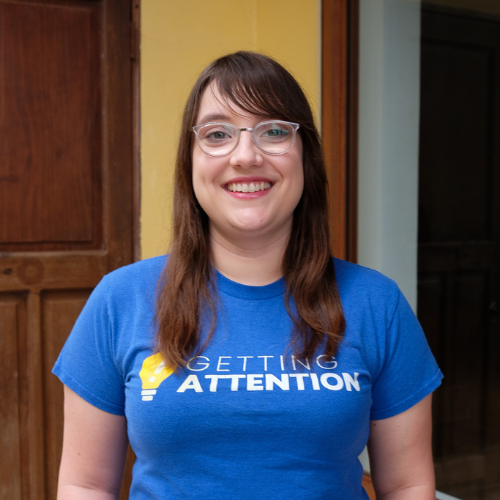
This guest post was written by Jessica King.
Jessica King is the director at Getting Attention, where she helps nonprofits get better results from their search marketing through smarter Google Ad Grant, paid Google Ads, and content strategies.
Prior to her work at Getting Attention, Jessica worked at nonprofits and in higher ed, where she focused on communication and digital marketing. Most recently, she worked in search engine optimization in the mission-driven sector.
Jessica holds a master’s degree in communication from Virginia Tech. In her free time, she likes to read, cook a new recipe, or hang out with her cats, Benny and Olive.
Ready for more? Here are two ways Erin can help you make your nonprofit mission irresistible to donors:
1. Connect with me on LinkedIn.
Let’s talk all things in the nonprofit realm, donor strategy ideas, and whatever catches our fancy.
2. Work with me.
I help nonprofit CEOs, directors, and teams grow donor partnership and impact with my Irresistible Mission System™.
✴️ Donors fund irresistible missions… is yours?
Schedule your 15-minute Change Chat here; let’s see if we should work together!